|
|
Posted By Christine Valentine, Concordia University of Edmonton,
6 hours ago
Updated: Friday, December 12, 2025
|
A case study from Concordia University of EdmontonRethinking a familiar governance tool Committees that support policy development and review go by many names—coordination committees, oversight committees, policy advisory groups—but their purpose is essentially the same: to bring an institution-wide lens to policy work. At Concordia University of Edmonton (CUE), we created a committee model that fits our size, culture, and governance structure, but had to work through some of the common problems these committees can encounter. Those pains ultimately helped us rethink our approach so the committee could continue doing meaningful work rather than becoming redundant. While every institution is unique (and some opt out of having such committees entirely), our experience may offer a few helpful insights for anyone considering establishing one or contemplating a refresh. When these committees work well, they centralize oversight, identify gaps, and bring together diverse perspectives, strengthening clarity, coherence, and risk awareness across policy documents. But they can also struggle when mandates grow too broad, overlap with existing roles, or lack shared standards for what makes a “good” policy. When this happens, committees can become overloaded and unclear in their purpose. In some cases, institutions may dissolve the committee and shift responsibility to an executive committee or legal counsel, resulting in a more centralized, leadership-driven decision-making structure rather than a broadly collaborative one. Yet the value of policy advisory committees, in my view, remains strong. When challenges arise, one option is to shift the committee’s focus, which is exactly what we did at CUE. This case study explores how we made that shift, moving from a coordination-focused model to a streamlined committee dedicated to policy document review grounded in clear institutional standards, transparent processes, and a sustainable mandate. The need for a new approach When I stepped into the role of policy and records analyst at CUE, our Policy Coordination Committee had already been playing a central and valuable role in the institution’s policy work. Like other policy advisory bodies, the committee reviewed policies for consistency, managed the policy review cycle, identified potential gaps, and provided institution-wide policy coordination. This structure was especially beneficial during the early stages of CUE’s policy program, when the committee helped guide major foundational projects that established several university policies.
As CUE grew, we began to see signs that the committee’s original model no longer aligned with the needs of our policy environment. Three insights, in particular, stood out: - Once its major foundation projects were completed, the committee struggled to define its ongoing purpose. The committee’s role in policy coordination no longer fit the reality of our policy environment.
- The committee’s responsibilities increasingly overlapped with my role as a policy administrator. This created duplication and a lack of clarity when it came to workflows.
- There was no documented standard for what constitutes a “good” policy. Committee discussions were often based on subjective interpretation rather than a shared standard.
As we examined the committee’s evolving role, it became clear that its coordination functions had become redundant. This insight prompted CUE to revise the committee’s terms of reference and formally establish the Policy Review Committee—a dedicated body responsible for reviewing all policy documents in line with clear institutional standards.
To support transparency and consistency, we also developed the Policy Document Checklist, which outlines the three standards for good policy design that CUE has adopted:
- Be clear: Policies are written in plain language, with short and simple sentences expressing a single idea, logical organization, and definitions aligned with standard institutional terminology.
- Be concise: Policies contain only rules with additional information moved to guidance documents. They are broad, enduring, and aligned with authorities.
- Be helpful: Policy documents use a positive and respectful tone, include enforceable statements, use inclusive terminology, and show evidence of meaningful engagement with the CUE community.
These statements now guide every policy document’s development and review. They are shared early with policy developers as a resource in the Policy Developers’ Toolkit, ensuring transparency, consistency, and a smoother review experience. By the time policy documents reach committee review, policy developers already know exactly what the committee will assess.
Practical tips for establishing a Policy Review Committee If you are thinking of reconfiguring an existing committee or establishing a new one, here are some practices that worked for us:
- Select members based on competencies. Ensure members have interest and experience in policy, not just positional representation.
- Keep membership small and nimble. Our committee currently includes five members appointed from the major organizational units of the university. Because policy consultation is expected to occur before a policy reaches the committee, the committee itself does not need broad, university-wide representation.
- Establish clear, shared standards. Tools such as our Policy Document Checklist give the committee a common reference point and help members ask focused, meaningful questions.
- Invite policy developers to participate. We begin meetings with a discussion among committee members, then invite the policy developer to hear feedback directly and respond to questions. This approach strengthens understanding and reduces back-and-forth.
- Prioritize committee orientation. Our first meeting each year is dedicated entirely to orientation. We review the standards, work through examples, and practice applying the criteria. This practice builds shared literacy and helps maintain consistency across membership transitions.
Reimagining our committee structure allowed us to build a model that fits CUE’s size, governance needs, and culture, but it is just one possible approach. Because institutions vary widely, policy practices should remain adaptable. In our case, a key strength of the Policy Review Committee is its direct connection with the policy developer, which has revealed an important reality: policy review can feel intimidating, especially for new drafters. For this reason, committees should not only focus on creating an effective structure but also be intentional about fostering spaces that are respectful and supportive. Ultimately, policy work is human. Approaching review with thoughtfulness, professionalism, and collaboration makes the process constructive and rewarding for everyone involved and helps build trust, foster shared understanding, and strengthen our sense of community.
Tags:
Christine Valentine
committees
governance
Policy Administration
policy process
policy review
strategy
tools
Permalink
|
|
|
Posted By Christine Valentine, Concordia University of Edmonton,
Tuesday, July 15, 2025
Updated: Monday, July 14, 2025
|
A practical addition to your policy programAs a policy administrator, few accomplishments are more meaningful than helping a colleague navigate a complex policy project. One of the most fulfilling aspects of my role as Policy & Records Analyst is providing guidance and support, especially when policy development and review feel unfamiliar or overwhelming.
At Concordia University of Edmonton (CUE), a small university in Edmonton, Alberta, known for its strong sense of community, that supportive spirit extends to our policy work. Our approach emphasizes collaboration, clarity, and long-term sustainability, ensuring that institutional policies remain aligned with the university’s vision, mission, and strategic objectives.
When I joined CUE, my aim was to establish a consistent, university-wide process for developing and reviewing policies. Early on, I recognized that building an effective policy program involves more than setting rules or monitoring compliance. It requires meaningful engagement with the people who contribute to the work. At CUE, policy development is a shared responsibility. Developers come from across the institution, bringing diverse expertise and varying levels of experience in policy writing. To support their success, I created the Policy Developers’ Toolkit—a user-focused resource designed to empower policy developers to engage confidently and effectively in the policy development and review process. Why we created the toolkitCUE’s five-step policy development and review process is designed to be straightforward, consistent across all policy instrument types, and easy to follow:
- A new policy action (creating a new policy or revising or rescinding an existing one) is proposed through a Policy Document Action Plan.
- Upon endorsement, the policy owner assigns a policy developer or development team.
- The development phase includes benchmarking, drafting, and consultation.
- The policy is submitted to the Policy Review Committee for review.
- Final approval is sought from the appropriate institutional authority.
Although the process itself is simple on paper, Step 3—development and revision by the policy developer—is often the most challenging. Policy developers are typically subject-matter experts, but they may not be familiar with translating their expertise into policy language that is clear, concise , and helpful.
As I worked alongside developers, I realized that providing one-on-one support for each project would not be sustainable long-term. I began by sharing checklists and other key reference documents, but it soon became clear that we needed a more comprehensive, centralized resource. The goal was twofold: to build confidence and understanding among our developers and to enable me, as the policy administrator, to manage multiple projects efficiently while still offering meaningful support.
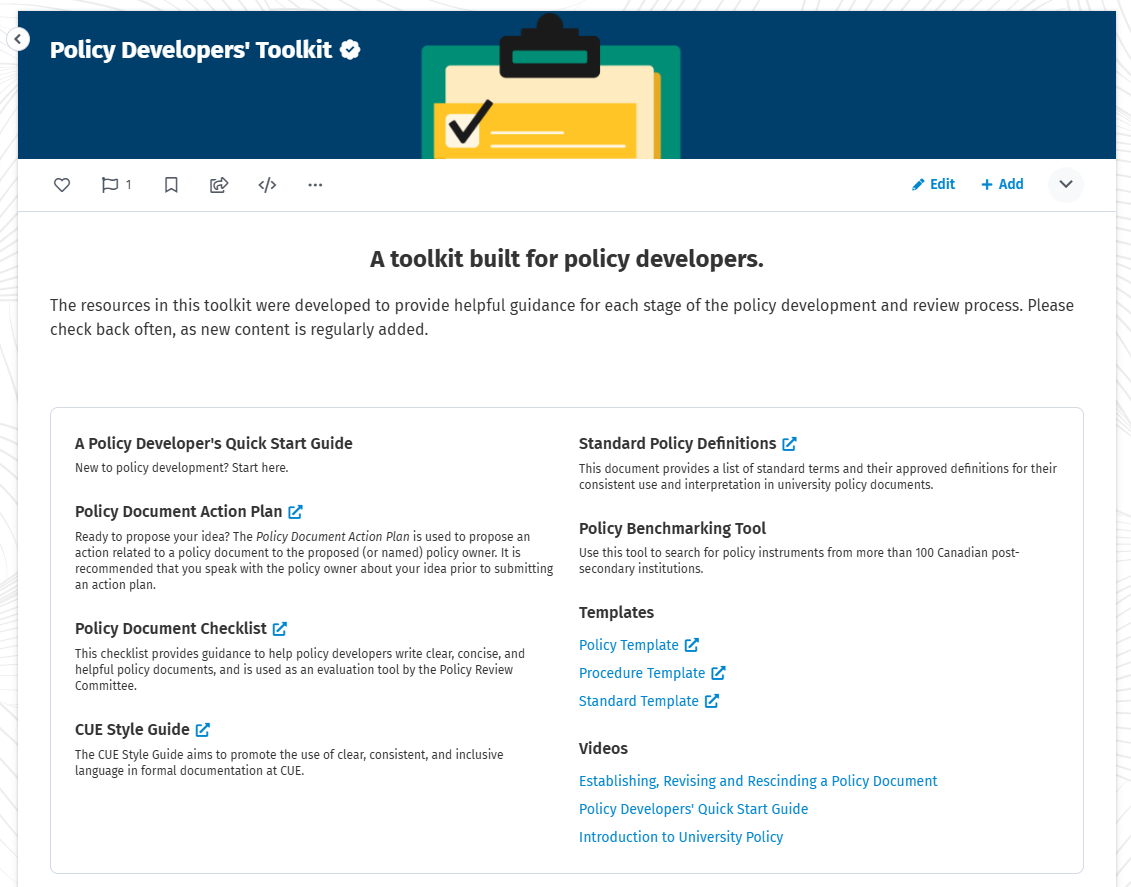
Bringing these resources together in a central repository also allowed me to understand how they worked together and identify any gaps. This insight allowed me to refine the tools, build coherence, and ensure the approach remained practical and user-friendly. What’s in the toolkit?The Policy Developers’ Toolkit is hosted in CUE Connect, our employee intranet. It is organized around the key stages of the policy development and review cycle, and is designed to meet developers where they are—whether they are new to policy work or more experienced.
Current resources include: - Policy Document Checklist – used by both policy developers and the Policy Review Committee to ensure policies are clear, concise, and helpful.
- Templates – standardized, fillable templates for various policy instruments.
- Standard Policy Definitions – to support clarity and consistency across all documents.
- Policy Benchmarking Tool – a custom Google search engine that scans 100+ Canadian post-secondary policy sites based on a keyword search.
- Instructional Videos – short walkthroughs, including a Quick Start Guide for new developers.
- Links to Key Resources – including our policy repository and essential documents like the Policy Document Action Plan.
Building Your Own ToolkitIf your institution does not yet have a policy development toolkit, or you are in the process of building one, here are a few steps I recommend:
- Find a Home for Your Toolkit: Use a central, easily accessible location such as an employee intranet.
- Start with What You Have: Gather existing resources like templates, checklists, and process guides.
- Communicate Often: Link to the toolkit in training materials, auto-replies, and communications with policy developers.
- Invite Feedback: Engage your users to learn what is working and what could be improved.
- Review and Improve: A good toolkit should evolve with your policy program. Make updates a regular part of your work.
When we launched our toolkit, it coincided with significant revisions to our Policy on University Policy Documents. This timing allowed the toolkit to support implementation and promote a smoother transition. A well-timed, accessible toolkit can be a powerful aid in navigating institutional change. Final Thoughts: Policy as a Community EffortTo me, policy work is one of the ways we express care for our institution and for one another. The Policy Developers’ Toolkit reflects that care by prioritizing clear guidance and accessible support to help our colleagues navigate what can sometimes feel like a complex process. While it is a practical tool, I also see it as a statement: policy work matters, and the people doing it deserve the right support to do it well.
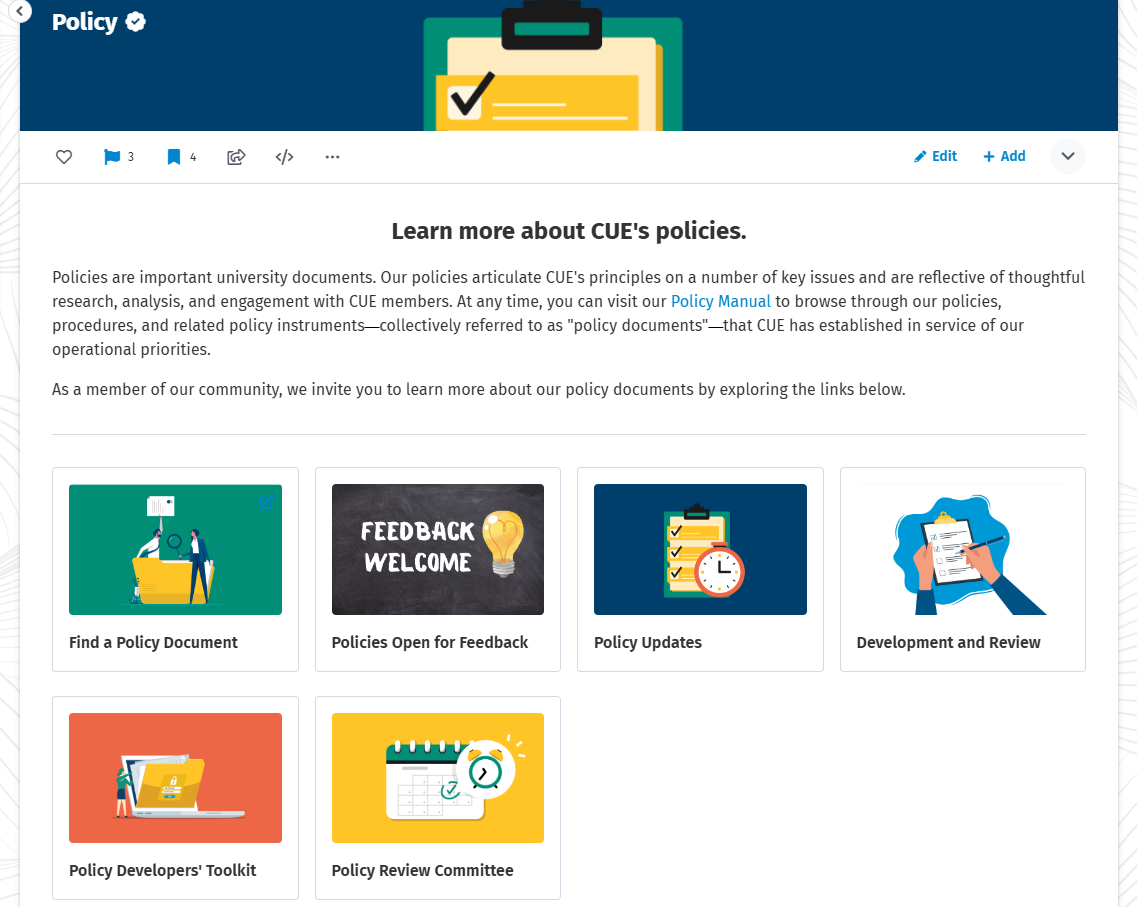
Over time, consistent communication helped embed the toolkit into CUE’s institutional culture. It has become a staple in our policy trainings, a standard reference in policy-related email communications, and a key component of our broader efforts to promote policy literacy. Housed within our centralized hub for policy information, the toolkit makes it easy for employees to find the right resources at the right time.
As the toolkit becomes further integrated into our policy infrastructure, we continue to expand its scope. Planned additions include interactive training modules and workshops designed to build engagement and deepen institutional capacity in policy development. In this way, the toolkit is not a static product, but a growing and evolving support system that reflects our commitment to a thoughtful, community-centered approach. 
As policy administrators, we know that policy work is both foundational and deeply human. While our documents provide structure, it is the people who shape them. The support they receive plays a vital role in ensuring policies reflect our institutional values and serve our communities well. By investing in the individuals who create and revise our policies, we help foster a culture of collaboration, inclusion, and shared purpose. - If you have tools or strategies that have proven helpful in your own policy toolkit, or if you are currently building one for your institution, I warmly invite you to share your insights and experiences. Please feel free to leave a comment or reach out to me at christine.valentine@concordia.ab.ca. I look forward to connecting and learning from your journey.
Attached Thumbnails:
Tags:
Christine Valentine
policy development
policy writer
resources
toolkit
Permalink
| Comments (0)
|
|